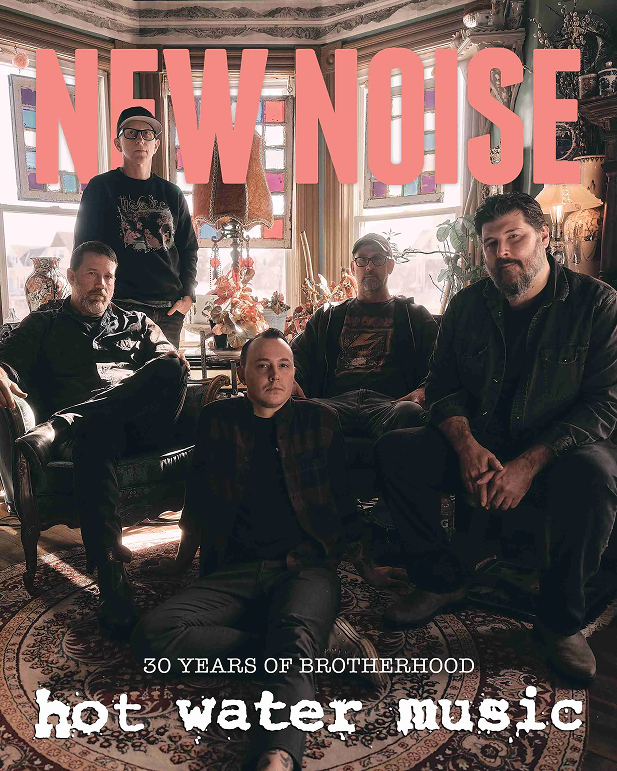
Hot Water Music, at their three-decade milestone as a band, have achieved something that only a handful of punk bands have ever accomplished: retaining all of their original members.
That’s not to say that it hasn’t been a grind to keep guitarist and vocalist Chuck Ragan, guitarist and vocalist Chris Wollard, bassist Jason Black, and drummer George Relbelo together. Since Hot Water Music’s inception in 1994, the band has gone through a number of changes, even while maintaining that original lineup, including two hiatuses, one of them due to Ragan leaving the band in 2006. Additionally, one member, Chris Wollard, stepped back from touring, with another member, Chris Cresswell of The Flatliners, added in 2017 to help fill that gap. Now on their second album as a quintet, Vows—which is out Friday from Equal Vision Records—finds the newly re-energized group working as a more seamless unit.
Chuck Ragan took a moment to sit down with us and talk about Vows and the history of this legendary punk band.
Hot Water Music are celebrating their 30th anniversary as a band. Most bands celebrate those sorts of things by re-releasing old material or doing a special tour. You chose to put out a new album. Is there any particular reason you wanted to do that to celebrate your anniversary?
Yeah, we’ve always been happy to have the opportunity to write and record new music. On the last record, on Feel the Void, we had what we thought was a great recipe. (Producer) Brian McTernan came back into the mix; we hadn’t worked with him in years, and it was a really special experience, and we wanted to do it again. And knowing that this year was going to be such a special and important milestone for the band we thought yeah, let’s go for it.
I don’t believe you can ever really force creativity. You can try and, sometimes, you can find some things that work here and there but, for the most part, we always feel like it needs to happen genuinely and organically. Nowadays, with Cresswell in the group and Wollard writing as well, you have five individuals who all create; we all write, and there’s a constant influx of material, so there was no shortage of material. We just needed to focus and bring Brian into the mix as well as Ryan Williams—who engineered (and) who we’ve made a lot of records with—and focus on a task at hand. We threw (together) all the material that we had and, as soon as we started doing that, we got really excited and just said “Yeah, let’s go for it. Let’s make a new record.”
The new album has several guest appearances. You have members of City and Color, Turnstile, Thrice, Calling Hours, and The Interrupters. I don’t think you’ve done anything like that since No Division in 1999, if I remember correctly.
Yeah, it’s been a while.
Why did you want to make your album collaborative like that?
Well, the coolest part about it to me is none of that was even really a thought or even an effort until our record was finished, or at least our work was finalized. In other words, we were done with our parts, with our playing and our sections, and were completely confident, felt great about the record, and Brian McTernan, as a producer, started throwing out some ideas (such as that) it would be super cool to have a backup vocal here or there that maybe was different than what we already have.
Then that got the creative juices flowing. And everybody had some ideas, but what was cool about it to me is there was no set agenda or goal, we just hollered at a bunch of friends and some of them came back and were able to do it. It just ended up being a really beautiful thing that were very, very honored and thankful to be a part of.
Particularly on the songs where you credit an entire band like Thrice or The Interrupters, how does that work? Did you double up on instruments? Or did they just provide vocals?
A little bit of both. Kevin and Aimee from The Interrupters, Kevin played some keys, and they both sang on “Much Love.” Most of it was either vocals or playing. I would defer that question to Brian McTernan; he was at the helm of producing the record, and he’s got a great ear for that stuff. He’s really good at picking out little harmonies or little nuances that a lot of people seem to miss. He’ll explain it, and you’ll kind of get it, but then he’ll have someone play it or sing it or what not, and it’s like a light bulb; like, “Oh, wow, I never thought of that.”